
Paramagnetism: Compounds
Vials of a number of compounds (NaCl, MnSO4, FeSO4, CoCl2, NiSO4, ZnSO4, K4Fe(CN)6, [Co(NH3)6]Cl3, [Ni(NH3)6]Cl2, and H2O) are hung from a thread. When a magnet is brought near, some of the vials are attracted. A ruler is used to measure the deflection of the thread from the vertical, which correlates with the number of unpaired electrons.
(85 )
Keywords
paramagnetism, electron configuration, magnetic properties, diamagnetism, electronic structure, periodic table, bonding, d block, transition elements
Multimedia
Introduction
 _Play movie (10 seconds, 0.5 MB)
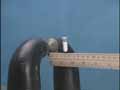
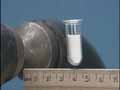
A series of compounds in small vials is brought close to the poles of a large, strong permanent magnet.
NaCl
 _Play movie (28 seconds, 1.7 MB)
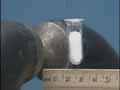
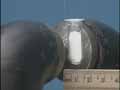

When a sample of sodium chloride is brought near the poles of the magnet, there is no attraction of the sodium chloride to the magnet, even when the vial strikes the magnet. There are no unpaired electrons in sodium chloride and sodium chloride is diamagnetic.
MnSO4
 _Play movie (17 seconds, 1.1 MB)
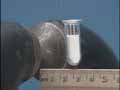

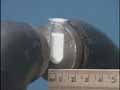
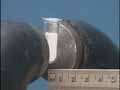
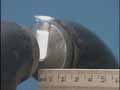
Manganese(II) sulfate monohydrate is strongly attracted by the magnet, which shows that it is paramagnetic. Manganese ions in manganese(II) sulfate monohydrate have five unpaired electrons.
FeSO4
 _Play movie (20 seconds, 1.2 MB)


Iron(II) sulfate pentahydrate can be brought closer to the magnet than the manganese(II) sulfate monohydrate, but eventually it swings toward the magnet. This compound is not as strongly paramagnetic as the manganese(II) sulfate. Iron(II) ions have four unpaired electrons.
CoCl2
 _Play movie (24 seconds, 1.5 MB)
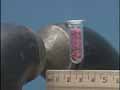


Cobalt(II) chloride hexahydrate can be brought closer to the poles than the iron (II) sulfate or the manganese(II) sulfate before it swings toward the magnet. Cobalt(II) ions have three unpaired electrons.
NiSO4
 _Play movie (28 seconds, 1.2 MB)


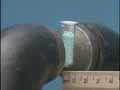
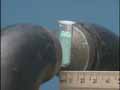

When nickel(II) sulfate hexahydrate is brought near the poles of the magnet, it appears to have about the same attraction as the cobalt(II) chloride, perhaps slightly less. Nickel(II) ions have two unpaired electrons.
ZnSO4
 _Play movie (28 seconds, 1.7 MB)


Zinc(II) sulfate heptahydrate is brought near the poles of the magnet. As in the case of the sodium chloride, there is no attraction between the zinc sulfate and the magnet. The degree of paramagnetism of these compounds of the transition metals can be correlated with the number of unpaired electrons in their metal ions.
K4Fe(CN)6
 _Play movie (21 seconds, 1.3 MB)
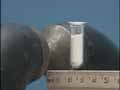
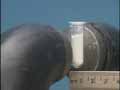

A sample of potassium hexacyanoferrate(II) is shown to be diamagnetic. The d orbitals in the iron(II) ions are split by the strong crystal field of the cyanide ligands, allowing all six electrons to pair.
[Co(NH3)6]Cl3
 _Play movie (20 seconds, 1.2 MB)

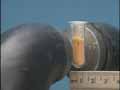

Hexaamminecobalt(III) chloride is not attracted to the poles of the magnet. As in the case of the hexacyanoferrate(II) ion, the strong field of the ammonia ligands splits the d orbitals and allows all electrons to pair.
[Ni(NH3)6]Cl2
 _Play movie (18 seconds, 1.1 MB)
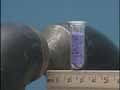
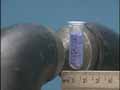
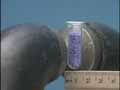
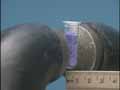

Hexaamminenickel(II) chloride is attracted weakly to the poles of the magnet. It has two unpaired electrons.
H2O
 _Play movie (24 seconds, 1.5 MB)
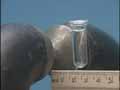


A sample of liquid water is tested and it is not attracted to the magnet poles; water is diamagnetic.
Discussion
a different presentation of the still images for this topic
Demonstration Notes: Warnings, Safety Information, etc.
Exam and Quiz Questions
1. Classify each compound tested as either paramagnetic or diamagnetic.
2. (Play without voice-over: Clip a or clip b) This substance might be
a. MnSO4 b. FeSO4 c. CoCl2 d. NaCl
3. (Play without voice-over: Clip c or clip d) This substance might be
a. MnSO4 b. NaCl c. KCl d. ZnSO4