
Safety Match Chemistry: Red Phosphorus and Potassium Chlorate
The chemical reaction that underlies common safety matches is demonstrated.
(150 )
Keywords
applications - practical/real-life, combustion reaction, enthalpy/heat, exothermic process, phosphorus/phosphorus oxides/phosphoric acid, redox reaction, strong oxidizing agent, strong reducing agent, thermochemistry/thermodynamics
Multimedia
 Play movie
(QuickTime 3.0 Sorenson, duration 18 seconds, size 1.5 MB)
Play movie
(QuickTime 3.0 Sorenson, duration 18 seconds, size 1.5 MB)
Potassium chlorate is sprinkled on a small mound of red phosphorus. A gentle tap with a hammer causes the mixture to explode.
 Potassium chlorate is mixed with red phosphorus. |
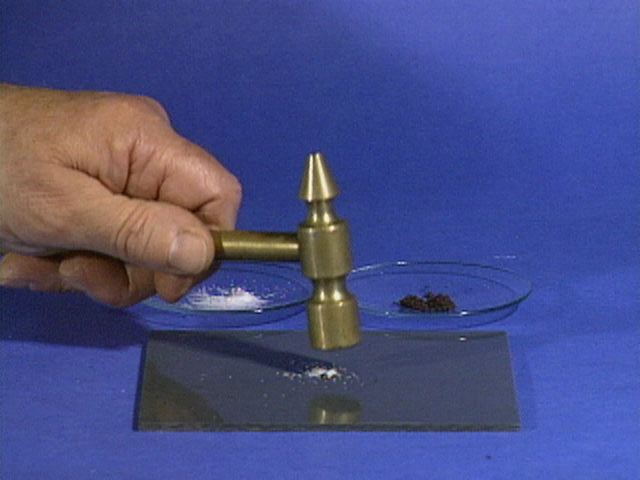 A gentle tap with a hammer... |
 ... causes the mixture to explode. |
Additional still images for this movie
Matches
 Play movie
(QuickTime 3.0 Sorenson, duration 20 seconds, size 1.6 MB)
Play movie
(QuickTime 3.0 Sorenson, duration 20 seconds, size 1.6 MB)
The gritty material on the side of a match-box is coated with red phosphorus. The match-head contains potassium chlorate and some red coloring. When the match-head rubs against the box, friction ignites the mixture of phosphorus and potassium chlorate.
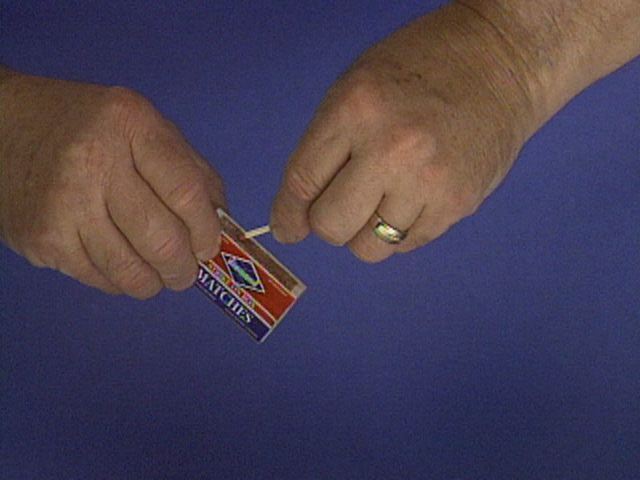 A match-box. |
 Friction ignites the mixture of phosphorus and potassium chlorate. |
Additional still images for this movie
Discussion
By separating the strong oxidizer (potassium chlorate) from the reducer (phosphorus) the matches are prevented from igniting spontaneously. Unlike the safety matches shown here, strike-anywhere matches are made with oxidizer and reducer together in the match head so that only friction or elevated temperature is required to ignite them.
Demonstration Notes, Warnings, Safety Information, etc.
Exam and Quiz Questions
1. In this reaction, which substance is the oxidizing agent? Which is the reducing agent?
2. What observable evidence indicates that a chemical reaction has taken place?