
Sulfuric Acid into Water and Ice
When sulfuric acid is mixed with water the temperature rises. When sulfuric acid is added to ice, the temperature rises at first, but as the ice melts, the temperature falls.
(144 )
Keywords
acids/bases, colligative properties, descriptive chemistry, endothermic process, enthalpy/heat, exothermic process, phase change, solutions/solubility, sulfur/sulfur oxides/sulfuric acid, water
Multimedia
Into Water
 Play movie
(QuickTime 3.0 Sorenson, duration 18 seconds, size 1.4 MB)
Play movie
(QuickTime 3.0 Sorenson, duration 18 seconds, size 1.4 MB)
Sulfuric acid and water both are near 0 degrees Celsius. The acid is poured into the water and the temperature rises.
 Acid is poured into water... |
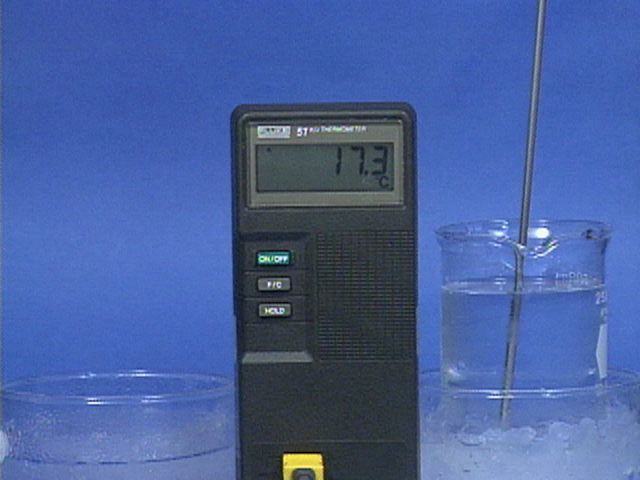 ... and the temperature rises. |
Additional still images for this movie
Into Ice
 Play movie
(QuickTime 3.0 Sorenson, duration 44 seconds, size 3.5 MB)
Play movie
(QuickTime 3.0 Sorenson, duration 44 seconds, size 3.5 MB)
Sulfuric acid and ice both are near 0 degrees Celsius. The acid is poured into the ice. Initially the temperature rises. Then it falls below 0 degrees Celsius.
 Sulfuric acid and ice both are near 0 degrees Celsius. |
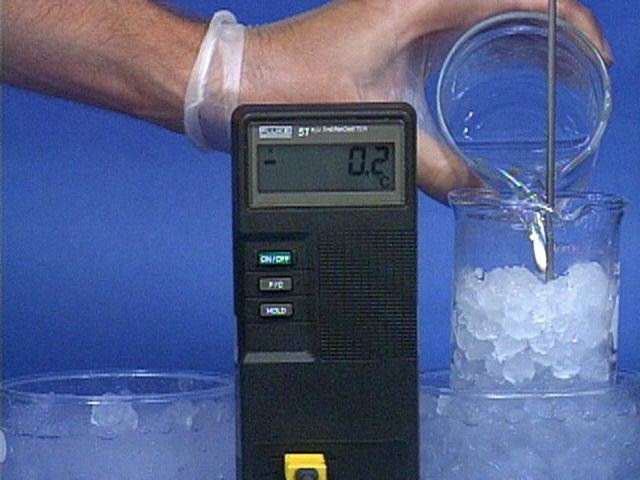 The acid is poured into the ice. |
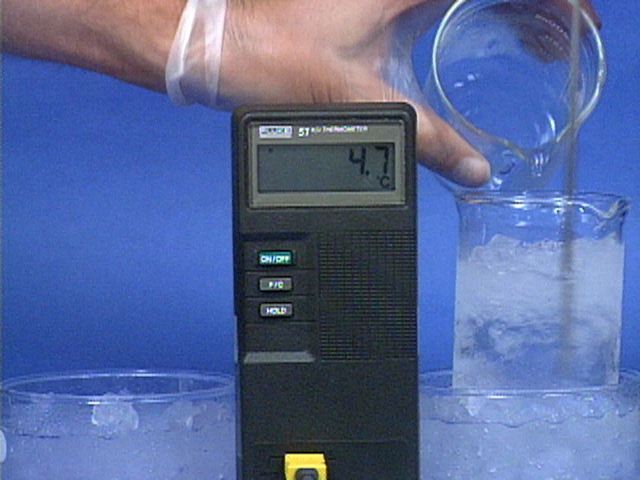 Initially the temperature rises. |
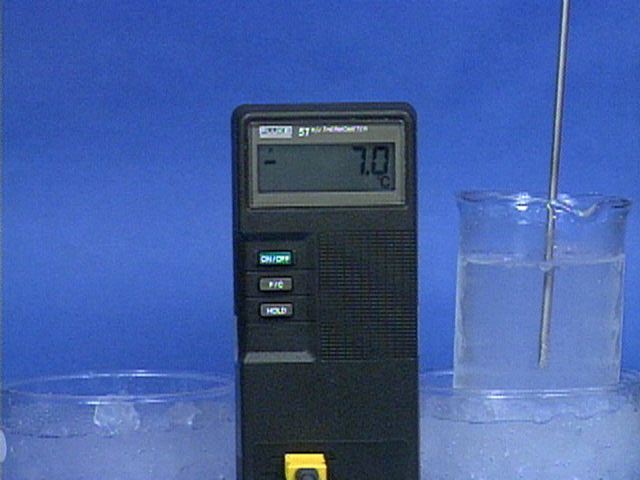 Then it falls below 0 degrees Celsius. |
Additional still images for this movie
Discussion
Dissolving sulfuric acid in water is an exothermic process. When sulfuric acid is mixed with ice this exothermic process causes the temperature to rise at first, but as more of the ice melts, the temperature falls. Because a sulfuric acid solution has a lower freezing point than water, the temperature can fall below 0 degrees Celsius if enough ice is present.The following are additional pictures relating to the first movie.
 Measuring the temperature of the sulfuric acid |
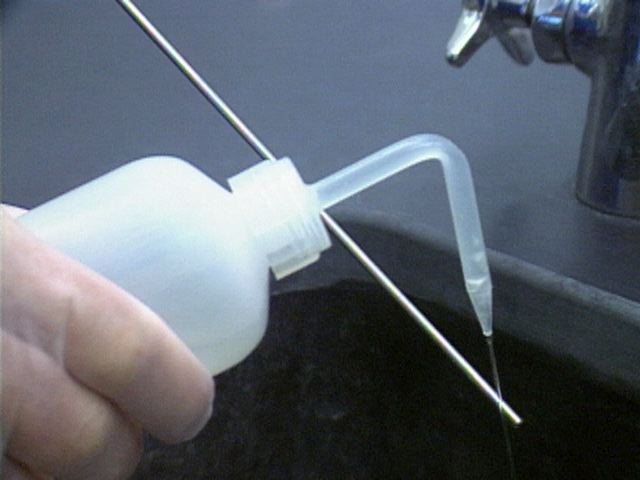 Rinsing the probe between measurements |
Demonstration Notes, Warnings, Safety Information, etc.
Exam and Quiz Questions
1. Explain in your own words why the temperature first rises and then falls when sulfuric acid is added to ice.
2. Explain why the temperature eventually falls below 0 degrees Celsius in this experiment.
3. How could you change the conditions of the experiment so that the temperature would first rise and then fall, but would never fall below 0 degrees Celsius?