
Ammonium Dichromate Volcano
An alcohol-soaked fuse is placed upon a small mound of ammonium dichromate and ignited. The orange ammonium dichromate decomposes to form nitrogen, water vapor, and fluffy greenish-black chromium(III) oxide. The equation for the reaction is given.
(30 )
Keywords
decomposition reaction, enthalpy/heat, evidence of chemical reaction, exothermic process, redox reaction
Multimedia
 Play movie
(QuickTime 3.0 Sorenson, duration 62 seconds, size 4.2 MB)
Play movie
(QuickTime 3.0 Sorenson, duration 62 seconds, size 4.2 MB)
The ammonium dichromate volcano illustrates what happens in a chemical reaction. The orange solid is ammonium dichromate. When a wick soaked in alcohol is placed into the ammonium dichromate and ignited with a match the higher temperature causes the ammonium dichromate to start reacting. The darker material which is forming is evidence of a chemical change. As the reaction proceeds it generates heat and the dark solid material is formed more rapidly. Flames and sparks can be seen shooting upward. The orange solid has been transformed into a dark gray-green solid and the temperature has changed. These observations are characteristic of a chemical reaction: a substance with one set of properties is transformed into one or more new substances with a temperature change.
 A wick is soaked in alcohol. |
 It is placed into the ammonium dichromate and ignited. |
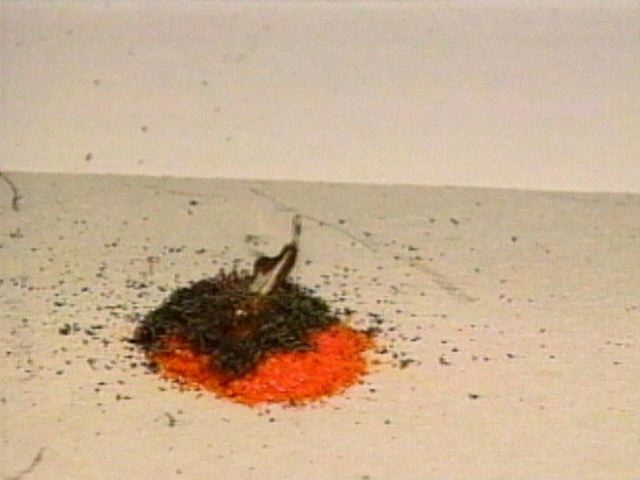 The darker material is evidence of a chemical change. |
 Heat is generated. |
Additional still images for this movie
Discussion
Equation
|
|
|
|
|
(NH4)2Cr2O7 |
|
N2 + 4H2O + Cr2O3 |
Demonstration Notes, Warnings, Safety Information, etc.
Exam and Quiz Questions
1. What observable evidence indicates that a chemical reaction is taking place?
2. What type of reaction is this? Include evidence from the video to support your answer.
3. Is this reaction endothermic or exothermic?
4. Is  H positive or negative for this reaction?
5. List as many observations as possible concerning this video segment.
6. What type of reaction is this? (Circle all that apply.)
a. combustion
b. decomposition
c. exchange
d. redox
e. combination