|
Home
Table of Contents
Keyword Index
Textbook X-ref
Search
About CCA!
|
 |
| Mechanism of Nucleophilic Substitution - SN1 |
| |
Click a thumbnail picture below to view a larger version. |

View Movie |
|
Narrative
For this animation of an SN1 reaction, the tetrahedral alkyl halide ionizes to form a planar, trigonal carbocation which may be attacked from either side by a nucleophile leading to racemization of a chiral halide.
Discussion
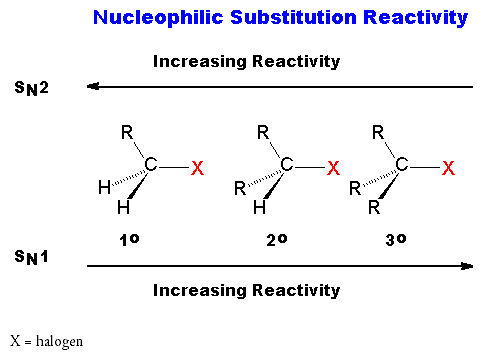
SN1 (substitution nucleophilic first order) reactions involve ionization of the alkyl halide to form a carbocation. This step is the slow, rate determining step, of the reaction. The carbocation is then attacked by a nucleophile in a fast second step to form the product. The stereochemistry of this process is simulated with a model. The tetrahedral alkyl halide forms a planar, trigonal carbocation which may be attacked from either side by a nucleophile leading to racemization of chiral halides. The order of reactivity or tertiary > secondary > primary halides parallels the stability of the corresponding carbocations.
|