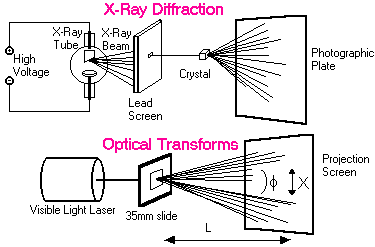
The structure of a crystalline solid can be determined using X-ray diffraction.X-rays from an X-ray tube are directed through a collimator at a crystal.The X-rays interact with the electron clouds of the atoms and diffract because the wavelength of the X-rays is about the same magnitude as the spacing between atoms.Photographic film can be used to detect the diffracted X-rays.The experiment can be scaled up by factors of thousands: diffraction can be illustrated using visible laser light, an array of laser-written, photographically-reduced dots on a 35-mm slide, and a projection screen.
|