

|
|
 |
|
 |
|
 |
|
 |
|
 |
|
 |
|
|
|
|
||||||||||||||
Bonding |
|
Click the image in the left-hand column below to view the movie. Alternatively, you may use the buttons in the upper right to browse the movies. |
|
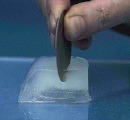 |
Diamond then Al with ice The first disk seen is a diamond wafer. Body heat from the hand holding the disk is rapidly transferred to an ice cube, enabling the diamond to rapidly melt a path through the ice cube. The second disk seen is made of aluminum. During the same amount of time, the aluminum does not pass as far through the ice cube, due to the lower thermal conductivity of aluminum relative to diamond. |
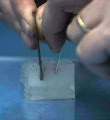 |
Diamond and Al with ice A diamond disk on the left and an aluminum disk on the right melt a path through an ice cube. Diamond transfers heat from the hand more readily and passes more quickly through the cube. |
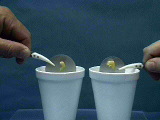 |
Diamond and Al with pasta Pasta noodles are attached with butter to a diamond disk on the left and an aluminum disk on the right. Hot water is poured into two foam cups. Simultaneously lowering the edges of the two disks into the hot water results in more rapid melting of the butter on the diamond disk. (Companion Demonstration 7.6) |
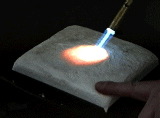 |
Shuttle tile A space shuttle tile is exposed to intense heat from a torch. Its poor thermal conductivity is illustrated by the ability to touch the tile a short distance away from the heated region. |
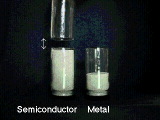 |
Sand bands Sand in bottles can be used to illustrate electrons in bands. The movie first shows an increasing band gap. The sand can move, representing electrical conduction, only in a partially filled bottle. (Companion Demonstration 7.1). |
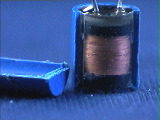 |
Choke coil A choke coil that has been cut open to expose its 150 m of fine copper wire is shown. (Companion Demonstration 7.4) |
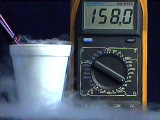 |
Choke coil cooling A multimeter is set to measure electrical resistance in ohms. The resistance of the choke coil is then measured to be about 150 ohms. Cooling the choke coil in liquid nitrogen reduces the electrical resistance by about a factor of ten. (Companion Demonstration 7.4) |
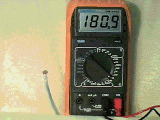 |
Photocell A multimeter is set to measure electrical resistance in ohms. The resistance of a CdS photocell shielded from light is too large to be on scale. Illuminating the photocell decreases the resistance to measurable values. When the multimeter has an audible conductivity setting (low resistance causes the meter to produce an audible sound), sound can be heard when the photocell is illuminated. (Companion Demonstration 7.9) |
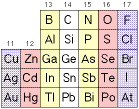 |
Chopsticks sound Semiconductor compositions for columns of the periodic table having an average of four valence electrons per atom. (Companion Figure 7.16) Moving equally in opposite directions across the periodic table to produce semiconductor compositions can be likened to playing the musical composition "Chopsticks." |
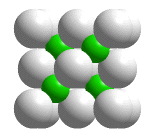 |
ZnS unit cell Many semiconductors possess the zinc blende structure, whose unit cell is shown. A portion of a structure that when repeated by moving it parallel to its edges by the length of an edge generates the entire crystal structure (without overlapping) is called a unit cell. When atoms are located on the corners, edges, or faces of the unit cell, only fractions of those atoms belong in the unit cell. The "unit cell" shown in this animation is actually the smallest collection of spheres that contains a single unit cell. |
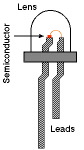 |
LED picture A diagram of a light-emitting diode (LED). (Companion Figure 7.22) |
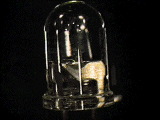 |
LED under microscope An operating LED, viewed under a microscope at 20x magnification while external background illumination is adjusted. With the darkest background illumination, only the glowing semiconductor is visible. (Companion Figure 7.22) |
 |
Color mixing from a tricolor LED A tricolor LED, comprising red, green, and blue LEDs in a single case. By varying the voltage applied to each LED independently, any desired color may be obtained, including white. (JCE, JCE, Companion Chapter 7 ) Tom Baraniak and Trish Ferrett |
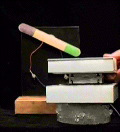 |
Thermoelectric unit A thermoelectric unit, which uses a temperature gradient to power a motor and turn a propeller. One side of the unit is cooled with ice and after a sufficient temperature gradient is established, the blade begins to turn. (JCE) |