

|
|
 |
|
 |
|
 |
|
 |
|
 |
|
 |
|
|
|
|
||||||||||||||
Equilibrium |
|
Click the image in the left-hand column below to view the movie. Alternatively, you may use the buttons in the upper right to browse the movies. |
|
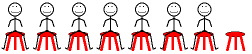 |
Chair model for holes Illustration of the opposite direction of movement of electrons (people) and holes (empty chairs). (Companion Figure 8.3) |
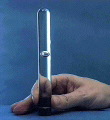 |
Glycerol setup Inversion of a partially filled tube of glycerine. (Companion Demonstration 8.1) |
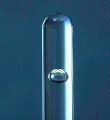 |
Glycerol hole Does the bubble float or the glycerine sink? By analogy, holes rise to reach lower energy in a band and electrons drop to reach lower energy in a band. (Companion Demonstration 8.1) |
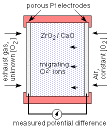 |
Oxide cell picture Diagram of a solid-state concentration cell that develops a voltage based on differential oxygen pressure. (Companion Figure 8.21) |
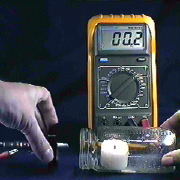 |
Oxygen sensor A four-wire automobile oxygen sensor with its shield cut off to expose the sensor element. Two of the wires lead to a heating element within the sensor and are powered to raise the temperature of the sensor and improve its oxide conductivity. The other two wires are connected to a multimeter set to read voltage. When both sides of the sensor are exposed to air there is no concentration gradient and no significant voltage is observed. When one side of the sensor is placed in an oxygen-depleted environment (created by burning a candle in a closed atmosphere), a voltage develops. |
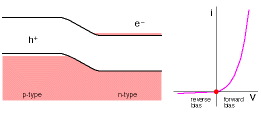 |
pn junction A diagram showing how the voltage applied to a p-n junction affects the current passing through the junction. (Companion Figure 8.15) |
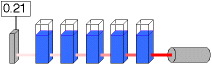 |
Beer's Law path A laser passes through a solution in a cuvette and illuminates a solar cell. Current from the solar cell is directly proportional to the light intensity. The log of the transmitted intensity is proportional to the number of cuvettes (path length). (Companion Demonstration 8.4) |
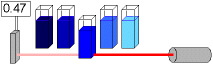 |
Beer's Law concentration A laser passes through a solution in a cuvette and illuminates a solar cell. Current from the solar cell is directly proportional to the light intensity. The log of the transmitted intensity is proportional to the concentration of the solution. (Companion Demonstration 8.4) |
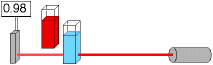 |
Beer's Law color A laser passes through a solution in a cuvette and illuminates a solar cell. Current from the solar cell is directly proportional to the light intensity. A blue solution absorbs more red light than does a red solution. (Companion Demonstration 8.4) |