

|
|
 |
|
 |
|
 |
|
 |
|
 |
|
 |
|
|
|
|
||||||||||||||
Thermodynamics |
|
Click the image in the left-hand column below to view the movie. Alternatively, you may use the buttons in the upper right to browse the movies. |
|
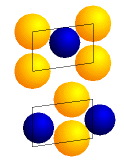 |
NiTi phases Atomic ballet of the solid-state phase transformation between the low and high temperature forms of nickel-titanium. These are layer sequences for z = 0, 1 and for z = 1/2. The unit cell that is rectangular in cross section is the high temperature phase. (Companion Figure 9.2) |
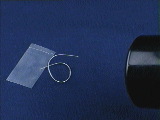 |
NiTi wires A piece of NiTi wire is wrapped around a finger, taped at one end to a surface, and heated with a hair dryer, restoring the wire to its original linear shape. (Companion Demonstration 9.2) |
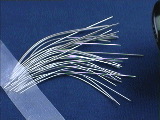 |
NiTi many wires The previous movie is repeated with a large number of nickel-titanium wires. (Companion Demonstration 9.2) |
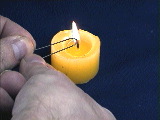 |
NiTi and candle A sample of nickel-titanium wire is "trained" to remember a new shape by bending it at high temperature in a candle flame. When this now V-shaped piece of wire is wrapped around a finger, taped at one end to a surface, and heated with a hair dryer, it is restored to its V-shape. (Companion Demonstration 9.3 and Experiment 10) |
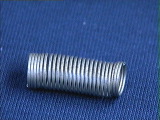 |
NiTi spring A sample of nickel-titanium in a spring shape is easily deformed in the low-temperature phase. Heating with a hair dryer restores the original spring shape and the high temperature form is resilient to deformation. |
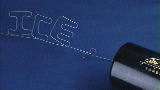 |
NiTi ICE A sample of nickel-titanium that spells out the initials of the Institute for Chemical Education is easily deformed in the low-temperature phase. Heating with a hair dryer restores the original shape. (Companion Demonstration 9.2) |
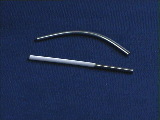 |
NiTi rods Two nickel-titanium rods of slightly different composition are shown. One is in the high-temperature form at room temperature and the other is in the low-temperature form. The latter is easily bent, but the former is not. Cooling the stiff, high-temperature-phase rod into its low temperature form makes it easier to bend. As it warms back to room temperature, the rod straightens. A heat gun is used to straighten the other, low-temperature-phase rod. (Companion Demonstration 9.4) |
 |
NiTi ring thud sound Oscilloscope traces, recorded using a microphone, of samples of both phases of nickel-titanium rods that have been struck. (Companion Demonstration 9.6) Does the high temperature, symmetric phase or low temperature, less symmetric phase give the ringing sound? Which one thuds? (Companion Demonstration 9.6 and Experiment 10) |
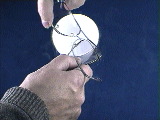 |
NiTi eyeglasses Nickel-titanium flexible eyeglass frames are made in the high temperature phase to exploit their superelasticity. When cooled with liquid nitrogen, the low temperature phase is easily bent. The frames are restored to their original shape by returning to room temperature. (Companion Demonstration 9.5) |
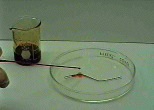 |
NiTi and Br2 The reaction of bromine in methanol with NiTi memory metal is sufficiently exothermic that the wire, if initially bent, will straighten as it goes through its phase change while decomposing. (article in Chem. Materials, 4, 700, (1992); Chapter 9 Companion) |
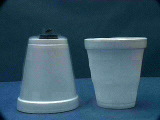 |
Superconductivity setup A 1-2-3 superconducting pellet is cooled in liquid nitrogen and placed on an inverted foam cup containing liquid nitrogen. When a magnet is placed over the pellet, it is levitated by the superconductor. (Companion Demonstration 9.7) |
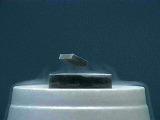 |
Superconductivity levitate A magnet is placed on a 1-2-3 superconducting pellet. When the pellet is cooled into its superconducting state with liquid nitrogen, the magnet rises. (Companion Demonstration 9.7) |
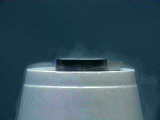 |
Superconductivity loss A magnet is levitated above a cooled 1-2-3 superconducting pellet. As the pellet warms up above its critical temperature, the magnet falls. (Companion Demonstration 9.7) |
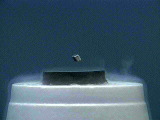 |
Superconductivity small magnet A small magnet that is levitated above a cooled 1-2-3 superconducting pellet is pushed with nonmagnetic tweezers. (Companion Demonstration 9.7) |
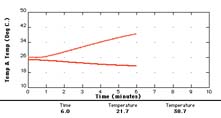 |
Peltier cooler When electrical energy is supplied to a Peltier cooler, the temperature differential between the two faces increases. (JCE) |