|
|
|
C
|
|
- cal
- Abbreviation for calorie; a unit of energy (or heat or work); equal to 4.184 J.
- calcination
- The heating of a solid below its melting point to decompose it, such as the heating of calcium carbonate to drive off carbon dioxide gas and form solid calcium oxide.
- calorie
- A unit of energy (or heat or work); equal to 4.184 J; abbreviated cal.
- calorimeter
- A device for measuring the heat released or absorbed during a chemical reaction.
- capillary action
- The spontaneous movement of a liquid into thin tubes or fibers; determined by adhesive forces, cohesive forces, and surface tension.
- carbohydrate
- The functional group of a carbon atom doubly bonded to an oxygen atom; found in aldehydes and ketones.
- carbonyl
- The functional group of a carbon atom bonded to a hydroxyl group and doubly bonded to an oxygen atom; found in carboxylic acids: -C(=O)OH.
- carboxyl
- An organic compound containing the functional group -C(=O)OH.
- carboxylic acid
- The increase in rate of a reaction due to the presence of a substance that undergoes no net change during the reaction.
- catalysis
- Something that increases the rate of a chemical reaction without itself being a reactant or product.
- catalyst
- The electrode in an electrochemical cell toward which cations are drawn and where reduction occurs; the negatively charged electrode in a vacuum tube.
- cathode
- Electrons emitted from the surface of a cathode in a vacuum tube.
- cathode rays
- The attachment of an active metal to a system to protect the system from corrosion. The active metal serves as the anode, making the metal in the system a cathode.
- cathodic protection
- A positively charged ion, attracted toward the cathode in an electrolytic cell.
- cation
- Abbreviation for cubic closest packed; one of two schemes for closest packing of spheres; described as "abc" to indicate that the atoms of the third layer do not lie directly above the atoms of the first layer.
- ccp
- The voltage of an electrochemical cell; the larger the cell potential, the greater the extent of reaction when equilibrium is reached.
- cell potential
- The temperature scale defined by the values 0 °C for the freezing point of water and 100 °C for the boiling point of water; a °C is the same size as a kelvin.
- Celsius
- In a small molecule or ion, the atom to which the other atoms are bonded.
- central atom
- The metal ion to which the ligands are attached at the center of a coordination complex
- central metal ion
- One of two or more compounds having the same chemical composition but differing in the arrangement of the atoms (usually carbon atoms) forming the backbone of the structure of the compounds; also known as skeletal isomer.
- chain isomer
- A reaction in which a product reacts so as to continue the reaction.
- chain reaction
- One of the elements in the same column of the periodic table as oxygen.
- chalcogen
- The statement that the volume of a sample of gas is directly proportional to the temperature of the gas (at constant pressure).
- Charles's law
- Used to refer either to a polydentate ligand or to the combination of a polydentate ligand and a central metal ion.
- Chelate
- A polydentate ligand; a molecule or ion which can occupy more than one site in the coordination sphere of a metal ion.
- chelating agent
- A process in which one or more substances are changed into one or more different substances.
- chemical change
- A representation of a chemical reaction in which chemical symbols represent reactants on the left side and products on the right side.
- chemical equation
- A represention of the elemental composition of a species; subscripts are used to indicate the relative numbers of atoms of each kind of element present.
- chemical formula
- A characteristic of a material that describes the material's chemical composition or reactions.
- chemical property
- A process in which one or more substances are changed into one or more different substances.
- chemical reaction
- A one- or two-letter abbreviation for an individual element.
- chemical symbol
- Referring to an ion or molecule that cannot be superimposed on its mirror image.
- chiral
- The separation of a mixture into its components by taking advantage of the components' different affinities for a stationary phase and a mobile phase.
- chromatography
- Abbreviation for curie; a unit of radioactive decay; equal to 3.70 x 10¹⁰ disintegrations per second.
- Ci
- Describing the relationship between groups attached to two doubly bonded carbon atoms and located on the same side of the double bond. Also referring to groups located adjacent to each other in an octahedral or square planar coordination complex.
- cis
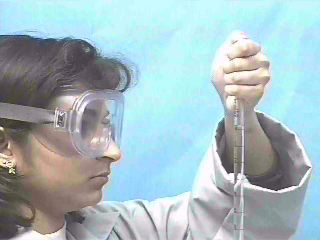
- A clean piece of glassware is one which has been washed with soap and water, and rinsed with tap water and then distilled water. No water droplets adhere to it when it is rinsed with distilled water.
- clean
- A clean piece of glassware is one which has been washed with soap and water, and rinsed with tap water and then distilled water. No water droplets adhere to it when it is rinsed with distilled water.
- codon
- An intermolecular force between like molecules, important in the phenomenon of surface tension.
- cohesive force
- Characteristics of a solution that depend upon the concentration of particles in the solution, but not on the nature of the particles.
- colligative property
- The rate at which chemical species collide; used in theories of chemical kinetics. Also, the frequency with which gaseous molecules collide.
- collision frequency
- A mathematical description of the number of collisions between molecules in a sample of matter per unit time; useful for predicting rates of reaction.
- collision theory
- A mixture containing particles larger than those found in a solution but small enough to remain suspended for a very long time.
- colloid
- A mixture containing particles larger than those found in a solution but small enough to remain suspended for a very long time.
- colloidal dispersion
- The vigorous combination of a material with oxygen gas or other oxidant, often resulting in a flame.
- combustion
- A method for determining the chemical composition of a compound by burning the compound under controlled conditions. Often used to determine the relative amounts of carbon and hydrogen in a compound.
- combustion analysis
- The influence on an equilibrium by the presence of a substance which contains ions that participate in the equilibrium.
- common ion effect
- An ion formed by the combination of a central metal ion and ligands.
- complex ion
- A material made up of two or more elements and having those elements present in definite proportions.
- compound
- A measure of the ratio of the amount of a substance to the amount of solvent, solution, or ore. Also, the process of making something more concentrated.
- concentration
- An electrochemical cell in which the two compartments contain the same solutions, but at different concentrations.
- concentration cell
- The process of a liquid forming from vapor.
- condensation
- The kind of polymer that is formed by the combination of monomers and the release of a small molecules at the point where monomers are joined.
- condensation polymer
- A notation for representing which atoms are bonded to which others in a chemical compound without showing the bonds between atoms. For example, CH3CH2OH is the condensed formula for ethanol.
- condensed formula
- One of the spatial arrangements of the atoms in an ion or molecule that differ by which atoms are attached to each other.
- configuration
- In an ion or molecule, one of the spatial arrangements which differ by rotation about single bonds, but which do not differ in which atoms are attached to each other.
- conformation
- The acid formed when a base accepts a hydrogen ion.
- conjugate acid
- The base formed when an acid releases a hydrogen ion.
- conjugate base
- The collection of broad spectral bands of a chemical species; distinguished from a line spectrum in which the bands correspond to individual wavelengths.
- continuous spectrum
- A rod in a nuclear reactor that variably absorbs neutrons in order to control the rate of fission.
- control rod
- A ratio with units that is multiplied times a quantity in order to express that quantity in different units.
- conversion factor
- A bond between two atoms in which the shared electrons are considered to be contributed by only one of the atoms.
- coordinate covalent bond
- An ion or molecule formed by the combination of ligands and a central metal ion.
- coordination complex
- The electrically neutral combination of one or more ligands and a central metal ion.
- coordination compound
- One of two or more coordination complexes having the same chemical composition but differing in which ligands are attached to the metal ion(s).
- coordination isomer
- The number of atoms to which an atom is bonded; in a coordination complex, the number of positions where ligands are attached to the central metal ion; in a ionic compound, the number of ions of opposite charge surrounding an ion.
- coordination number
- In a coordination complex the region around a central metal ion where the ligands are attached to the metal ion.
- coordination sphere
- The structural degradation of a metal or alloy by electrochemical oxidation.
- corrosion
- The attachment of atoms to one another by the presence of a pair of shared electrons.
- covalent bond
- A compound in which atoms are attached to one another by the presence of pairs of shared electrons.
- covalent compound
- An indication of the size of an atom in a covalent compound; often measured as half the internuclear distance between like atoms bonded to each other.
- covalent radius
- The minimum mass of a fissionable nucleus necessary for a sustained chain reaction to occur.
- critical mass
- The conditions of temperature and pressure above which no distinction exists between a liquid and its vapor.
- critical point
- The pressure required to convert a gas to a liquid at the critical temperature of a substance.
- critical pressure
- The highest temperature at which the vapor of a substance can be converted to a liquid.
- critical temperature
- The study of the behavior of matter at temperatures below -200°C.
- cryogenics
- A solid form in which the atoms, molecules, or ions are arranged in a regular, repeating fashion.
- crystal
- A theory that explains properties of coordination complexes in terms of electrostatic attractions between the ligands and the metal ion and the resulting different energies of d orbitals.
- crystal field theory
- The points in space that define the locations of the repeating units in a crystal.
- crystal lattice
- One of two schemes for closest packing of spheres; described as "abc" to indicate that the atoms of the third layer do not lie directly above the atoms of the first layer.
- cubic closest packed
- A unit of radioactive decay; equal to 3.70 x 10¹⁰ disintegrations per second; abbreviated Ci.
- curie
- A cuvette is a vessel used to hold a sample within a spectrophotometer.
- cuvette
- A hydrocarbon containing no multiple bonds between carbon atoms and containing a ring of carbon atoms.
- cycloalkane
- A hydrocarbon containing no multiple bonds between carbon atoms and containing a ring of carbon atoms.
|
|
|