|
|
|
M
|
|
- magic number
- One of the numbers 2, 8, 20, 50, 82, and 126; nuclei having this number of neutrons or protons (or both) exhibit great stability.
- main-group element
- One of the elements in the area of the periodic table over which the s and p atomic orbitals are being filled; also called representative element.
- malleable
- Able to be pounded into shape
- manometer
- A device for measuring the pressure of a gas in relation to the pressure of the atmosphere.
- mass
- A measure of the quantity of matter; the force required to impart unit acceleration to an object.
- mass defect
- The difference in mass between an atom and the atoms from which it could be formed. This difference is released as energy in a nuclear reaction.
- mass number
- The sum of the numbers of protons and neutrons in an atom; these two kinds of particles contain almost all of the mass of an atom.
- mass spectrometer
- An instrument that measures the mass of ions by accelerating them through electric and magnetic fields.
- mass spectrum
- The record of fragments formed in a mass spectrometer presented as a plot of abundance against atomic mass.
- matter
- Anything that occupies space and has mass; contrasted with energy.
- mean free path
- The average distance that gas molecules travel between collisions.
- melting
- The process of a liquid forming from a solid.
- melting point
- The temperature at which a solid becomes a liquid. Also called freezing point.
- meniscus
- The meniscus is the curvature of a liquid in a vessel at the liquid air interface. It is caused by attractive forces between the solution and the walls of the vessel. In cases where the solution wets the sides of the vessel, you should measure the volume from the bottom of the meniscus. Position the vessel so that your eyes are level with the bottom of the meniscus as shown above. If your eye level is above or below the line of sight shown in the picture, your reading will be in error.

- messenger RNA
- The RNA that conveys information from the genetic code on DNA to a ribosome where transfer RNA attaches the correct amino acid to a growing protein; abbreviated mRNA.
- meta
- Describing the relationship between two groups attached to carbon atoms on a benzene-like ring which have one carbon atom between them.
- metal
- An element characterized typically by a glossy surface, thermal and electrical conductivity, malleability, and ductility.
- metallic radius
- The distance between atoms in a metal; found from the internuclear distance.
- metalloid
- An element having properties intermediate between a metal and a non-metal.
- metallurgy
- The study of metals and their extraction from ores.
- meter
- The SI unit for distance.
- miscible
- Able to dissolve in each other in any proportion.
- mixture
- A combination of two or more substances in which the substances retain their chemical identity.
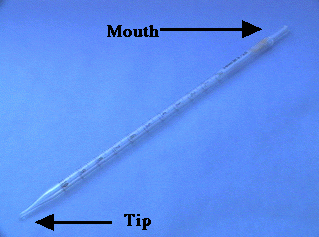
- mohr pipet
- This is a Mohr pipet. It is used for transferring specified volumes of liquid from one container to another.
- molality
- A concentration unit expressed as moles of a substance per kilogram of solvent.
- molar mass
- The mass of a mole of substance; the same as molecular weight for molecular substances.
- molar solubility
- The extent to which a solute dissolves in a solvent expressed as the number of moles of a substance that will dissolve per 1 L of solution.
- molarity
- A concentration unit expressed as moles of a substance per liter of solution.
- mole
- That amount of a substance containing the same number of units as 12 g of carbon-12.
- mole fraction
- In a mixture, the number of moles of one substance divided by the total number of moles of all substances present.
- molecular formula
- The chemical formula of a substance written using the subscripts that reflect the number of each atom present in a molecule of the substance.
- molecular orbital
- An orbital formed by the overlap of atomic orbitals; designated as bonding, non-bonding, or anti-bonding.
- molecular orbital diagram
- A diagram depicting the relative energies and the occupancy of the molecular orbitals in an ion or molecule.
- molecular orbital theory
- The theory that describes covalent bonding in terms of orbitals that are formed by the combination of atomic orbitals on different atoms.
- molecular weight
- The mass of one mole of molecules of a substance; the molar mass of a molecular substance.
- molecule
- A set of atoms joined by covalent bonds and having no net charge.
- monomer
- One of the units that joins with other units to form a polymer.
- mRNA
- Abbreviation for messenger RNA; the RNA that conveys information from the genetic code on DNA to a ribosome where transfer RNA attaches the correct amino acid to a growing protein.
- multidentate
- Referring to a ligand attached to a central metal ion through two or more atoms.
|
|
|